
What Improved Because Your Teams Adopted Agile?

Agile pays off when people can show which delivery constraint changed, how performance improved, and why the change helped.
Your organization invested in agile adoption. People were trained, roles were introduced, and teams changed how they planned and reviewed their work. The expected return should be visible in more dependable commitments, faster customer feedback, shorter delivery delays, and a more controlled response to changing priorities.
Demonstrating that return requires practitioners who can examine how work moves, identify what is limiting performance, and test a change against measurable evidence.
Give practitioners the skills to improve delivery
Servant leadership is a valuable foundation for Scrum Masters and agile coaches. Listening, facilitating, and helping teams take ownership all matter.
Certification introduces a shared vocabulary and foundational practices. Diagnostic and measurement skills develop through guided practice: establishing a baseline, investigating a constraint, designing a test, and interpreting the result.
“Run an experiment” provides limited guidance when someone has never been taught how to connect a delivery problem to a testable hypothesis.
In my Delivery Practices Advocates Program, I taught practitioners to use hypotheses to structure improvement. An improvement idea carries an assumption about what will change and why. Making that assumption explicit gives the team something it can examine.
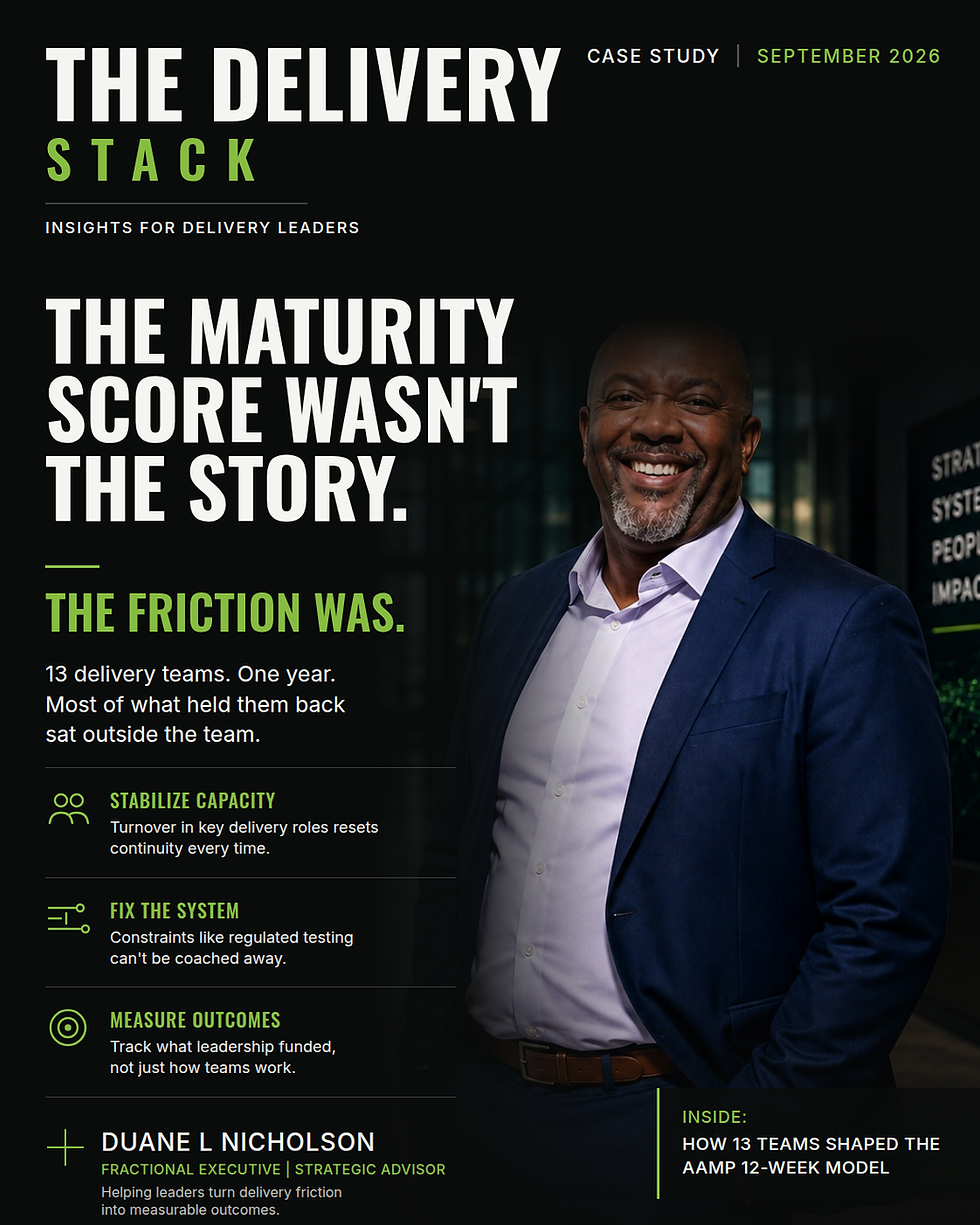
My earlier article, The Maturity Score Wasn't the Story, explores a related lesson from work across thirteen delivery teams: better practice scores can coexist with constraints that still prevent delivery.
Start with the mainframe team’s objection
A familiar objection from mainframe teams is that they cannot deliver in a two week cadence. The scenario below illustrates how to investigate that concern. The packaging hypothesis is an example to test, rather than a reported client outcome.
Before recommending smaller stories or more frequent releases, understand what “deliver” means in that environment.
Walk through the development process with the team. Examine analysis, coding, compilation, testing, integration, and acceptance. Then understand ChangeMan, a software change and configuration management tool used in mainframe environments, including how its change packages are grouped, approved, and promoted.
The work grouping deserves particular attention. Some changes may need to move together because they share dependencies. Other changes may travel together because that is how the process has traditionally been organized. The investigation needs to distinguish those conditions.
A story can finish development while its package waits for another change. Testing may depend on a shared environment. Production promotion may follow an established release schedule. Each condition points to a different intervention.
Measure the boundary the team can influence
Start with Ready to Complete.
Agree on what Ready means, what Complete means, and which steps sit between them. If Complete means tested and accepted, record production release separately. If packaging is required for completion, include it explicitly.
Starting the clock when development begins can exclude waiting that occurs after the team has accepted the work as ready.
The broader lead time still matters to the business. It may also contain upstream prioritization and other delays beyond the team’s immediate influence. Beginning with Ready to Complete gives the team a practical boundary for investigation.
Measure | What it reveals |
Throughput | How many comparable work items reach Complete during each period |
Ready to Complete elapsed time | How long completed items spend moving through the agreed process |
Waiting time by step | Where work waits for testing, packaging, approvals, or another input |
Age of unfinished work | Whether stalled items are overlooked when reviewing completed work |
Keep the work types and completion rules consistent. Splitting work into more items can increase the throughput count without making the underlying delivery process faster.
Turn the finding into a hypothesis
Suppose the investigation shows that independent changes regularly wait because they share a ChangeMan package. An illustrative hypothesis would be:
We believe grouping independently releasable changes into separate packages will reduce package waiting time and shorten Ready to Complete elapsed time, because completed changes will no longer wait for unrelated work.
Before testing that change, the team needs to confirm that separate packaging is technically and operationally appropriate.
Then establish the baseline, target, observation period, and quality safeguard. Compare package waiting time before and during the test. Review throughput alongside work size and mix. Monitor promotion failures and corrective rework.
If waiting decreases while quality remains stable, the result supports the hypothesis. If it does not, investigate what happened. The dependency may have been misunderstood, another constraint may dominate, or the observation period may provide insufficient evidence.
The experiment should produce learning that informs the next decision.
Make leadership part of the improvement
Some findings will require action beyond the team. A shared environment, conflicting priorities, approval authority, or an established release policy may require a leadership decision.
A capable practitioner makes the constraint and its consequence visible, identifies who can act, and follows through. Leadership must provide the authority and support required to change those conditions.
That responsibility also appears in When an Initiative Stalls, Who Owns the Recovery?, which examines ownership when progress requires a leadership intervention.
NBD’s Delivery Intelligence offers address both the delivery constraint and the capability needed to keep improving.
Delivery Performance helps identify the constraint, test an intervention, and determine whether delivery improves.
Ownership Evolution develops the internal leadership capability to continue that work and sustain the gains.
The return on agile adoption becomes credible when people can explain what improved, show the evidence, and connect the result to a deliberate change.
For the mainframe team, that begins with understanding its delivery process. The two week objection becomes a starting point for investigation, and the evidence determines what can improve.
Find where delivery needs attention
Use the Delivery Intelligence Scorecard to identify where delivery risk sits across the foundations, performance, and ownership of your delivery system. Use the result to focus the next investigation and improvement conversation.
About the author
Duane L. Nicholson is Founder and Chief Transformation Officer of NBD Consulting Services and a Fractional Executive & Strategic Advisor. He works with technology, product, and delivery leaders on modernization, operating model change, and strategic execution. His experience includes DTCC, Experian, Amgen, Toyota Financial Services, and Pacific Life. He designed the Delivery Practices Advocates Program and is a SAFe Practice Consultant (SPC).


Comments